Tiger behaviour in Satpura National Park follows the terrain. The reserve rises from the Tawa backwaters at about 300 metres to Dhoopgarh at 1,352 metres, and the hills between hold less prey per square kilometre than the flat sal and meadow of the eastern Madhya Pradesh parks. We did not find a published home-range or territory size for Satpura's tigers, so this page gives none; general tiger ecology is labelled as such, and Satpura-specific reports carry a date and source. The population figures themselves are on the tigers page.
Prey: why Satpura tigers travel further
Low prey density explains most of the rest. Hashim Tyabji of Forsyth Lodge told Forbes India that the rugged, hilly terrain limits prey numbers and therefore tiger numbers. The reserve's own prey-supplementation page says ungulate densities are 'currently low' and records 1,567 chital brought in from Pench between 2016 and 2022 to raise them. Barasingha reintroduced from Kanha since 2015 now graze the Bori meadows and Malini in Churna. In general tiger ecology, where deer are thin on the ground tigers hold larger ranges and spend more time moving between the valleys where prey concentrates.
Day, night and the summer water
Tigers everywhere are most active from dusk to dawn and rest through the heat; that is textbook. Where they rest is specific to this park. The Sonbhadra river runs along the Lagda route, and RoundGlass Sustain notes that sloth bears hide in the rocky alcoves of the Madhai side in summer; the same shade serves cats. The official best-time page says summer gives the best sightings, and the mechanism is the usual one: from April the hill streams dry and animals come down to the Denwa, the Sonbhadra and the few perennial pools. Morning drives in summer start at 05:45 under the official timings.
Mothers, cubs and the orphans that arrived
Two recent cases show what happens to cubs when a mother is lost. The three-year-old tiger released in Churna on 23 to 24 December 2024 was a Bandhavgarh animal whose mother had been moved to Rani Durgavati Tiger Reserve. The two males of about two years captured near Bhojpur on 31 March 2025 were held in an enclosure inside the reserve for nine months and released in Churna around 2 January 2026. In general tiger ecology cubs stay with their mother until about two years old and then disperse; the Bhojpur pair were at that age. Both releases went into Churna, which has had prey augmentation and the lightest tourism load of the core.
Dispersal: out towards Melghat and out towards the villages
The reserve's significance page describes a tiger-bearing habitat of more than 10,000 square kilometres extending from Satpura to Melghat in Maharashtra, and the WPSI's reading of the 2022 estimate counts 149 tigers in that Satpura-Melghat block. The other direction reached the news in July 2026, when ETV Bharat reported two tigers, one of them T-56, ranging near Tawanagar and Kesla villages with capture attempts under way. In August 2025 T-66, a male of 11 to 12 years, was found dead in the Lagda beat, and the deputy director suspected a territorial fight. A man collecting mahua in the core was killed by a tiger in April 2026. This is why the core has rules about where you can and cannot step out.
How to read the forest on a Satpura drive
Guides here rely on sign more than on radio reports. These cues are general field-craft, used in every Indian tiger forest:
- Alarm calls. Chital give a sharp repeated bark; sambar a deep single bell; langur a coughing alarm from the canopy. One call can be a leopard or a dhole. Several species calling from the same patch, moving in one direction, means wait.
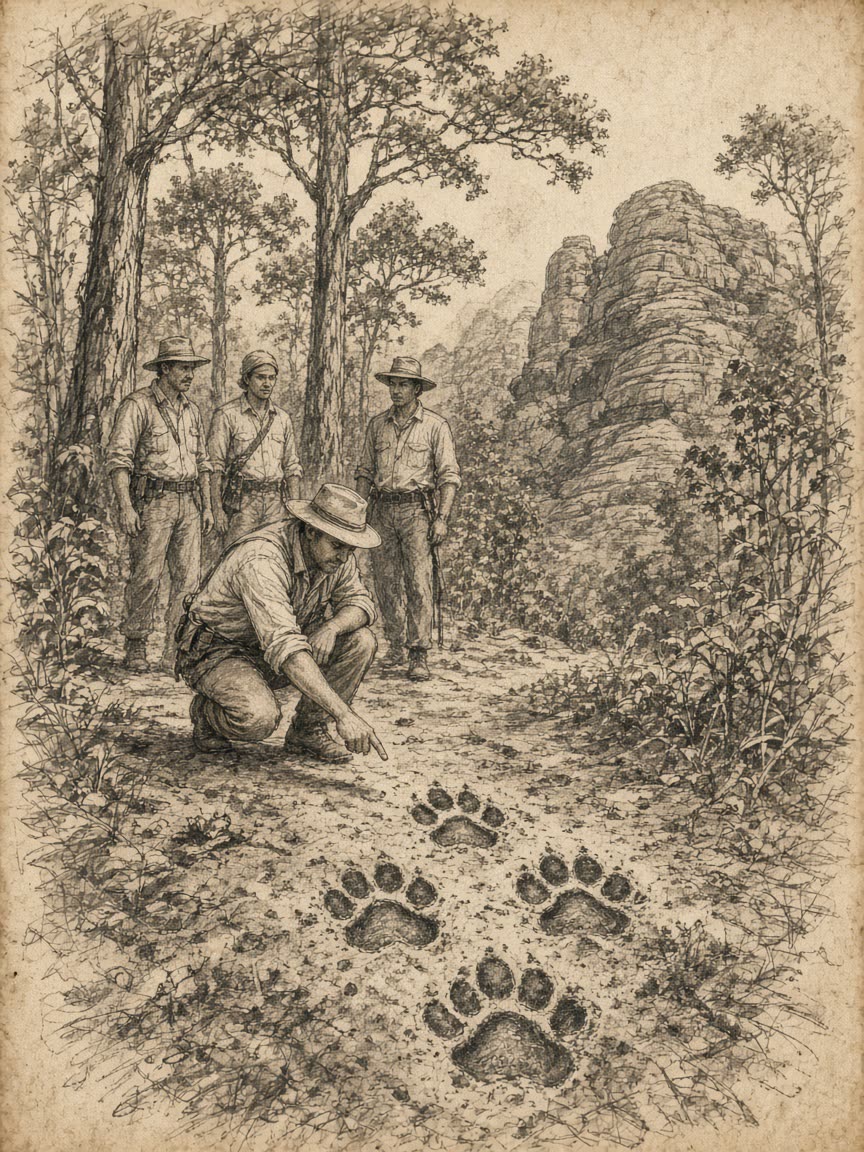
- Pugmarks. Fresh prints on a dusty track from the morning, before any vehicle has passed, show direction and roughly how long ago. The guide will read whether the track is a male (broad, squarer) or a female (narrower), but treat that as a reading, not a fact.
- Scrapes and scent. Tigers rake the ground with their hind feet and spray trees along regular routes. A line of fresh scrapes along a road means a resident is using it.
- Water in summer. From April, sit at a pool rather than drive.
- Silence. On a Churna drive you may be the only vehicle in the range; switch the engine off at junctions and listen.
On foot: what the rules are and why
Forbes India describes Satpura as the only tiger reserve where walking safaris are allowed inside the core, in small supervised groups for two to three hours in the morning. We could not find that 'only' claim on the official site, so treat it as a journalist's summary. The MP Forest FAQ is precise: stepping off a vehicle is prohibited in the core except on the designated tracking and rock-climbing routes at Pachmarhi and Madhai, boots and trousers are to be worn on trails, and a guide is mandatory. Walking is covered on the walking safaris page and the forest experience page.
Sources
- Satpura Tiger Reserve: Supplementation of prey
- Satpura Tiger Reserve: Significance
- Satpura Tiger Reserve: Best time to visit
- Satpura Tiger Reserve: Barasingha reintroduction
- MP Forest FAQ: Satpura (MPOnline PDF)
- Forbes India: Satpura, treading lightly in tiger land
- RoundGlass Sustain: Guide to Satpura National Park (2023-09-24)
- WPSI: Tiger status
- Free Press Journal: Bandhavgarh's 3-year-old tiger relocated to Satpura (2024-12-24)
- ETV Bharat: Two cubs released in Satpura Tiger Reserve (2026-01-04)
- ETV Bharat: Two tigers leaving Satpura core area (2026-07-09)
- Deccan Herald: Tiger dies in Satpura, territorial fight suspected (2025-08-13)
- ETV Bharat: Man killed by tiger while collecting mahua in Satpura (2026-04-10)
FAQ
Tiger Behaviour: Satpura FAQ
- Why are tiger sightings in Satpura less frequent than in Kanha or Bandhavgarh?
- The reserve's hilly terrain supports fewer prey animals, which keeps tiger density low; the reserve itself says ungulate densities are currently low and has brought in 1,567 chital from Pench since 2016. Tigers spread over 1,339 square kilometres of core with few tourism roads.
- Can you walk in the core zone of Satpura?
- Yes, on designated tracking routes at Pachmarhi and Madhai with a mandatory guide, wearing boots and trousers. Elsewhere in the core, stepping off the vehicle is prohibited under the MP Forest FAQ rules.
- Do Satpura tigers leave the reserve?
- The reserve connects to a tiger-bearing landscape of over 10,000 square kilometres reaching Melghat. In July 2026 two tigers, including T-56, were reported ranging near Tawanagar and Kesla villages on the reserve's edge.
Ready to see a wild tiger?
From the first call to the last transfer, we're with you. We book the safari zones the day they open, choose the lodges, arrange every train, flight and road journey, and stay on call while you travel.
Plan My Safari