Figures as of 2025-07-31 · page checked 2026-11-18
Sariska Tiger Reserve in Alwar district, Rajasthan, has a longer human history than most Indian tiger reserves. The forest sits in the Aravalli range between about 300 and 722 metres, and people have built inside it for well over a thousand years: a group of 10th-century Hindu and Jain temples at Neelkanth, a fort at Kankwari that Aurangzeb is said to have used as a prison, a Hanuman temple at Pandupol that draws lakhs of pilgrims a year, and a hunting palace from the 1890s. The history of Sariska is the history of a princely hunting preserve that became a sanctuary, then a Project Tiger reserve, then the place where India lost every tiger and started again.
Alwar's hunting ground
Before independence, Sariska was the favoured hunting ground of the princely state of Alwar, and it was strictly protected for that purpose, according to the Wildlife Protection Society of India. Wikipedia puts the same point more bluntly: the forest was preserved for hunting for the Alwar state before 1958. Hunting preserves kept the forest standing, and that is the forest the sanctuary was later notified on.
The clearest relic of that period is the Sariska Palace. The hotel's own website says it was built in 1892 by Maharaja Jai Singh of Alwar, designed by a French architect, to mark a visit by the Duke of Connaught, a son of Queen Victoria, and that it later served as the royal hunting lodge. The same page says the property is currently under renovation, so check before you plan a stay around it. We could not find any source for the 1902 date that sometimes appears for the palace; the hotel's own claim is 1892.
From sanctuary to tiger reserve: a timeline
| Year | Event | Source |
|---|---|---|
| 1845 | Siliserh Lake created by Maharaja Vinay Singh of Alwar, who dammed a tributary of the Ruparel River | Wikipedia (Siliserh Lake) |
| 1892 | Sariska Palace built as a hunting lodge under Maharaja Jai Singh | Sariska Palace hotel website |
| 1955 or 1958 | Declared a sanctuary. WPSI gives 1955; Wikipedia and Outlook Traveller give 1958 | WPSI; Wikipedia; Outlook Traveller |
| 1978 or 1979 | Brought under Project Tiger. WPSI and the Wikipedia article text say 1978; Outlook Traveller and the Wikipedia infobox say 1979 | WPSI; Wikipedia; Outlook Traveller |
| 1982 | Primary notification declaring part of the core a National Park, about 273.8 km2 | WPSI; Wikipedia |
| 2004 to 2005 | Tigers found to have been wiped out; a Central team confirmed it on 17 February 2005 | ThePrint (30 Sep 2025); The Tribune (29 May 2005) |
| 2008 | First tiger flown in from Ranthambore on 28 June 2008 | NTCA brief note |
| 2025 | NBWL Standing Committee approves a boundary rationalisation on 26 June 2025 | The Week/PTI (10 Jul 2025); The Tribune (11 Jul 2025) |
Two of these dates conflict in the sources, and we have left both in the table rather than choosing one. The reserve's core is notified as critical tiger habitat under Section 38V of the Wildlife (Protection) Act 1972, at 881.11 km2 according to the NTCA brief note. The full area figures, which also vary by source, are on our biodiversity page.
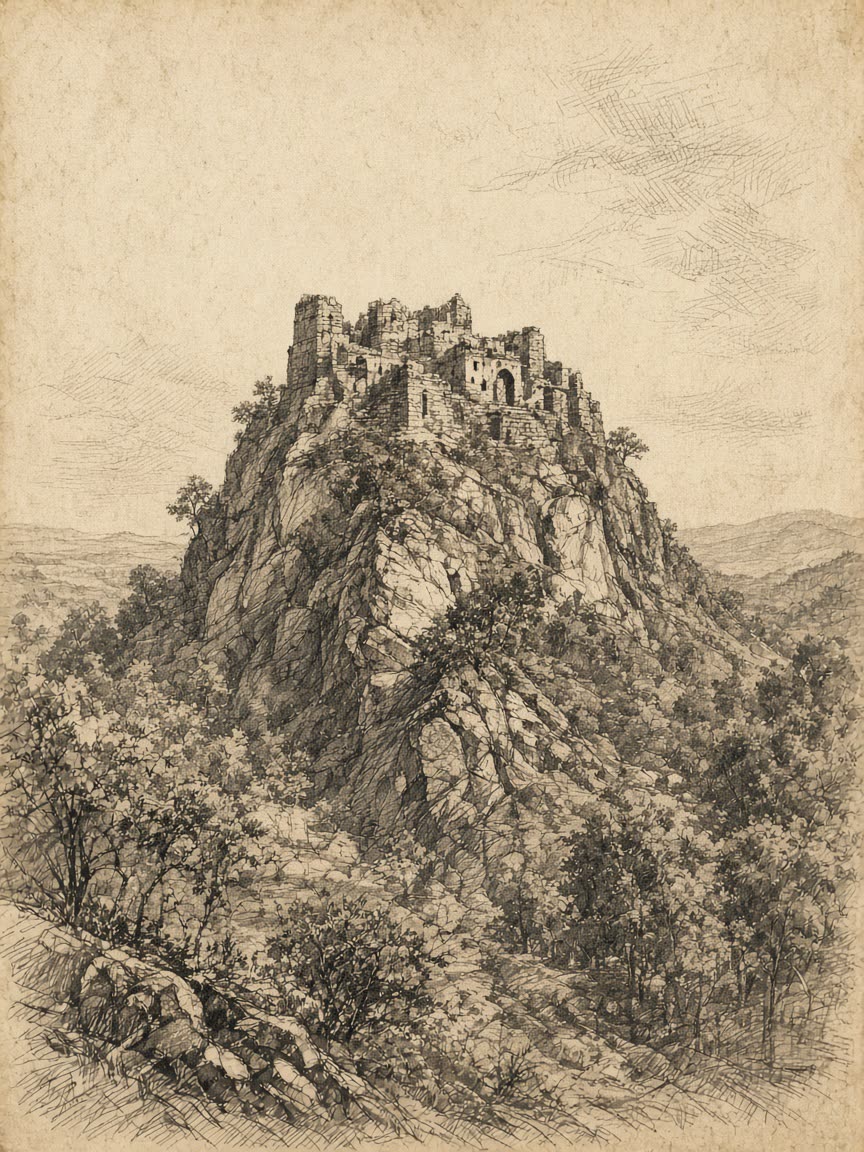
Kankwari Fort
Kankwari, also spelled Kankwadi, is a fort on an isolated hill inside the reserve, reached by a 15 km track that branches off past the Tehla road. Powlett's Gazetteer of Ulwur (1878), cited in the Wikipedia article on Kankwadi, says Jai Singh II founded the fort as famine-relief work. The same article carries the fort's best-known story: Aurangzeb briefly imprisoned his brother Dara Shikoh here in the 17th century. The article gives no specific citation for that claim, so treat it as tradition rather than settled fact.
The village below the fort was evicted in 2009, with three families still there in August 2016, and the fort has since been renovated for tourism. Kankwadi was still listed in January 2025 among the three priority villages awaiting relocation out of the core, along with Haripura and Kraska. Booking sites place the fort on the Zone 3 and Zone 5 safari routes, which is how most visitors see it. Our zone guide has the routes.
The Neelkanth temples
On the Tehla side of the reserve, at the site called Neelkanth, Rajorgarh or Paranagar depending on the source, stands a group of about a dozen temple structures spread over roughly 2 km. The Jio Institute's exhibit on the group dates the triple-shrine Neelkanth Mahadev temple to the late 10th century CE on stylistic grounds, and records an inscription of VS 1016, which is 960 CE. A Ganesh inscription is dated 953 CE, and the Jain Naugaza Shantinatha temple, with its colossal Jina image, carries an inscription of 923 CE. The builders were a branch of the Pratihara dynasty under rulers named Savata and Mathanadeva; the Badgujar Rajas added the walls in the 18th century.
Outlook Traveller describes the site more loosely as the ruins of over 300 Hindu and Jain temples from the 8th to 12th centuries, with carvings resembling Khajuraho. The two accounts differ on scale, and the dated inscriptions are the firmer evidence. Neelkanth falls on the Zone 3 and Zone 5 safari routes.
Pandupol
Pandupol, around 22 km inside the core according to ThePrint and Outlook Traveller (Jaipur Stuff puts it at about 18 km from the main gate), is the reserve's living religious site. The Government of India's Incredible India page tells the legend: during the Pandavas' exile Bhima met an old monkey blocking his path, could not move it, and learned it was Hanuman, come to teach him humility. Bhima is then said to have carved the natural opening in the rock that gives the place its name. Wikipedia adds that Bhima killed the demon Hidimb here and married Hidimba, and notes a spring and a 35-foot waterfall beside the small Hanuman temple.
The temple is open 6 AM to 7 PM, and crowds come on Tuesdays and Saturdays. The Lakhi Mela during Chaitra Navratri in March and April draws around 50,000 devotees according to Incredible India. The Central Empowered Committee's 2024 report counted 2 to 3 lakh visitors to the July and August mela and 8 to 10 lakh a year, and identified about 305 temples inside the reserve in all. That traffic is now the subject of a Supreme Court case, covered on our conservation page.
Siliserh and Bhangarh, on the edges
Siliserh Lake, 15 km south-west of Alwar by Incredible India's reckoning, was built in 1845 by Maharaja Vinay Singh, who dammed a tributary of the Ruparel River and built a palace on the shore for his wife. The palace is now an RTDC hotel, and the lake covers about 7 km2, rising to 10 km2 after a good monsoon. In July 2025 the CEC noted that the environment ministry has proposed Siliserh as a Ramsar wetland of international importance.
Bhangarh Fort sits at the edge of the reserve, 65 km or about an hour and a half from Jaipur. The town was established in 1573 (VS 1631) by the Kachwaha ruler Bhagwant Das for his second son Madho Singh. An Archaeological Survey of India signboard prohibits entry before sunrise and after sunset; locals say spirits enter after dark. Both places are on our nearby attractions page.
What a visitor can see today
The hunting-preserve past survives in the Sariska Palace, closed for renovation by its own account, and in the shape of the protected forest itself. Inside the reserve, Kankwari Fort and the Neelkanth temples are reached on safari routes through Tehla, and Pandupol on the Sariska Gate routes. Siliserh and Bhangarh are outside the forest and can be visited on your own. For how to fit them around morning and afternoon drives, see Plan Your Visit and our Sariska hotels page.
Sources
- NTCA brief note on Sariska Tiger Reserve
- WPSI: Sariska Tiger Reserve
- Wikipedia: Sariska Tiger Reserve
- Outlook Traveller: Sariska National Park getaway guide
- The Sariska Palace (hotel website)
- Wikipedia: Kankwadi
- ETV Bharat: three villages awaiting relocation from Sariska core (2025-01-11)
- Jio Institute exhibit: Neelkanth Mahadev group of temples
- Incredible India: Pandupol Hanuman Ji Mandir
- Wikipedia: Pandupole
- ThePrint: Rajasthan to ban private vehicles to Pandupol (2024-08-08)
- Jaipur Stuff: private vehicles banned in Sariska (2024-08-09)
- ThePrint/PTI: unchecked traffic affecting wildlife in Sariska (CEC report) (2024-08-05)
- Wikipedia: Siliserh Lake
- Incredible India: Alwar
- The Week/PTI: CEC interim report on Sariska (2025-07-31)
- The Week/PTI: Sariska boundary rationalisation (2025-07-10)
- The Tribune: Centre clears Sariska boundary proposal (2025-07-11)
- Wikipedia: Bhangarh
- ThePrint: the tiger roars again in Sariska (2025-09-30)
- The Tribune: Sariska after the tigers vanished (2005-05-29)
FAQ
History & Heritage: Sariska FAQ
- When did Sariska become a tiger reserve?
- Sariska came under Project Tiger in 1978 according to WPSI and the Wikipedia article text, or 1979 according to Outlook Traveller and the Wikipedia infobox. Part of the core was notified as a national park in 1982, covering about 273.8 km2.
- Who built Sariska Palace?
- The hotel's website says Maharaja Jai Singh of Alwar built it in 1892, with a French architect, to honour a visit by the Duke of Connaught. It became the royal hunting lodge and is currently under renovation, according to the same page.
- Can I visit Kankwari Fort?
- Only on a safari. Booking sites list the fort on the Zone 3 and Zone 5 routes through Tehla Gate, and Outlook Traveller describes a 15 km track to it off the Tehla road. Zone allotment is random, so the fort route cannot be guaranteed.
Ready to see a wild tiger?
From the first call to the last transfer, we're with you. We book the safari zones the day they open, choose the lodges, arrange every train, flight and road journey, and stay on call while you travel.
Plan My Safari