Figures as of 2026-11-18 · page checked 2026-11-18
Ranthambore National Park in Sawai Madhopur district, Rajasthan, was a royal hunting ground before it was anything else. The forest around Ranthambore Fort belonged to the Maharajas of Jaipur, who kept it for shikar, and Jogi Mahal beside Padam Talao was where the royal party rested between hunts. That building is now a forest guest house, and the lake in front of it is where most visitors get their first look at the park. This page covers the fort, the temples, the dates that turned a hunting preserve into a tiger reserve, and the people who did the work. For the wildlife side, start with the biodiversity guide.
The fort: who built it and when
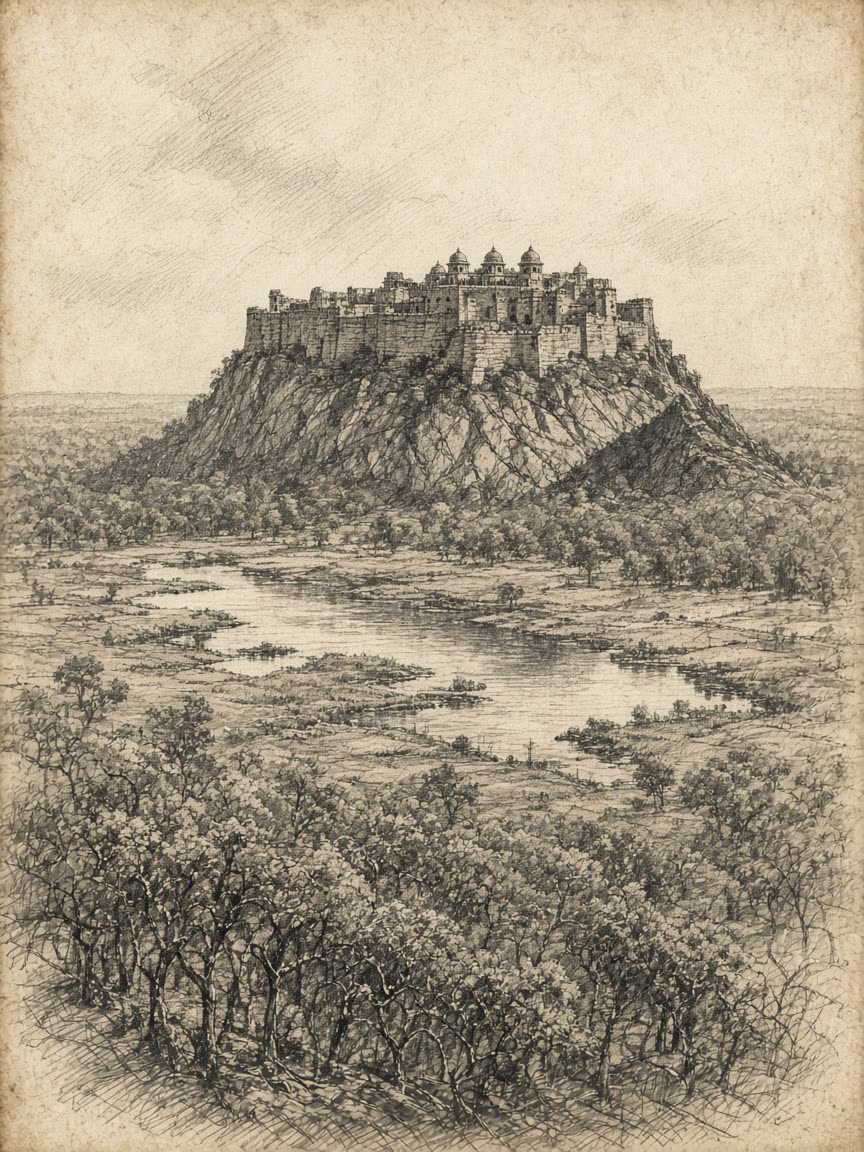
Nobody agrees on when Ranthambore Fort was founded. Wikipedia's fort page carries two versions: a 5th-century CE origin under a Maharaja Jayanta, and a mid-10th-century origin under Sapaldaksha of the Chauhan dynasty. The Hill Forts of Rajasthan page (the UNESCO series) says the site was settled by the 8th century and that construction most likely began in the mid-10th century under the Chahamanas, the Chauhans of Ranastambhapura. The 10th-century date is the one the heritage listing leans on.
The fort changed hands repeatedly. After Prithviraj III's defeat in 1192 it passed to Muhammad of Ghor. In 1299 the Chauhan ruler Hammiradeva gave shelter to a rebel general, Muhammad Shah, and Alauddin Khalji laid siege; the fort fell in 1301. Akbar took it in 1568. In the 17th century it passed to the Kachwaha Maharajas of Jaipur and stayed part of Jaipur state until Independence. Jaipur acceded to India in 1949 and became part of Rajasthan in 1950, and the forest around the fort went with it.
World Heritage status
In 2013, at the 37th session of the World Heritage Committee in Phnom Penh, Ranthambore Fort was inscribed as one of six Hill Forts of Rajasthan (reference 247rev) under cultural criteria (ii) and (iii). The inscribed fort site is 102 hectares with a 372-hectare buffer. The fort sits roughly 700 feet (210 metres) above the plain around it, which is why you can see it from so many points on a safari drive, and why the climb to the temple takes the time it does.
Temples inside the fort
The Trinetra Ganesh temple inside the fort is the reason Ranthambore is a pilgrimage site as well as a tiger reserve. It is one of three red-stone (Karauli stone) Hindu temples in the fort, dedicated to Ganesh, Shiva and Ramlalaji, built in the 12th and 13th centuries. Thousands of people visit every Wednesday. One operator describes the idol as Pratham Ganesha and says aarti is held five times a day. An NTCA policy brief from January 2016 put the annual footfall at 7 to 8 lakh pilgrims, which matters for the forest because the temple road runs through the reserve. There is also a Jain temple in the fort dedicated to Sumatinath and Sambhavanath.
From game sanctuary to tiger reserve
The protected-area story runs from the 1950s to 2008 and some of the dates conflict between official sources. We list both where they do.
| Year | Event | Source |
|---|---|---|
| 1955 | Sawai Madhopur Game Sanctuary created, 282 sq km | Wikipedia (park and Sawai Man Singh WLS pages) |
| 1973-74 | Included in Project Tiger (Wikipedia gives 1974) | NTCA tiger-reserve list; Wikipedia |
| 1980 | Declared a national park. An NTCA brief (Jan 2016) instead says the national park was notified in 1989 out of the Sawai Madhopur sanctuary | Wikipedia; NTCA Economic Valuation brief |
| 1983 | Kailadevi Wildlife Sanctuary notified in Karauli district, about 676.38 sq km, the reserve's northern extension | Wikipedia (Kailadevi WLS) |
| 1984 | Sawai Man Singh Sanctuary formally constituted, named after Maharaja Sawai Man Singh II of Jaipur (about 103 sq km in one part of the source, 130 sq km in another) | Wikipedia (Sawai Man Singh WLS) |
| 2007 | Tiger reserve last notified | NTCA tiger-reserve list |
| Dec 2008 | Critical Tiger Habitat notified | Land Conflict Watch |
| 2013 | Ranthambore Fort inscribed as a World Heritage Site | UNESCO; Wikipedia (Hill Forts of Rajasthan) |
The 1980 versus 1989 question is a real discrepancy between a widely cited encyclopaedia entry and an NTCA policy document. We have not found a third official source that settles it, so both dates stay on this page. The 2007 notification is the one that defines the tiger reserve as it exists today; the core and buffer areas are discussed on the biodiversity page and the conservation history page.
Fateh Singh Rathore
If one person made Ranthambore a tiger park, it was Fateh Singh Rathore. He was born on 10 August 1938 at Chordiyan near Jodhpur and joined Ranthambore as a Ranger in November 1971. He was Field Director from 1978 to 1987. His best-known achievement came early: by 1976 he had relocated 12 of the 16 villages inside the core, moving people out so the forest could recover. He was transferred to Sariska in 1987, resigned about two years later, and retired in 1996. In 1997 he founded Tiger Watch, the Sawai Madhopur NGO that still runs anti-poaching and community work around the reserve. WWF gave him a lifetime achievement award in February 2011. He died of lung cancer on 1 March 2011, aged 72. His protege, the writer and conservationist Valmik Thapar, died in 2025.
Machli, the tigress on a postage stamp
Machli (T-16), born in spring 1997 and named for the fish-shaped mark on her face, lived to 19 and died on 18 August 2016. She raised five litters between 1999 and 2006, 11 cubs in all, and two of her daughters were moved to Sariska in 2008 to restart that reserve. India Post issued a commemorative cover in 2013, and she received a TOFT lifetime achievement award (reported 2009). She was cremated publicly with Hindu rites. Her story, and the tigers descended from her, continue on the tigers page.
What you can still see today
- Ranthambore Fort itself, with its temples and ramparts, which is visited on foot, separately from the safari. Wednesday is the busiest pilgrim day.
- Jogi Mahal beside Padam Talao, the former royal rest house. One operator describes its banyan as the second largest in India; we have not found an official source for that claim.
- The ruins between Raj Bagh Talao and Padam Talao, passed on drives through the lakes zone (see zones).
- Dastkar Ranthambore, a craft project set up for families displaced by the park, about a kilometre from the main gate area (see nearby attractions).
A safari permit does not include the fort, and the fort visit does not include the forest. If you want both, plan a separate half day; see plan your visit.
Sources
- Wikipedia: Ranthambore Fort
- Wikipedia: Hill Forts of Rajasthan
- UNESCO World Heritage Centre: Hill Forts of Rajasthan (247rev)
- Wikipedia: Ranthambore National Park
- Wikipedia: Sawai Man Singh Wildlife Sanctuary
- Wikipedia: Kailadevi Wildlife Sanctuary
- NTCA: list of tiger reserves
- NTCA: Economic Valuation of Ranthambore Tiger Reserve (policy brief) (2016-01)
- Land Conflict Watch: relocation from Ranthambore Tiger Reserve
- The Better India: Fateh Singh Rathore (2020-08-05)
- Tiger Watch annual report 2024-25
- Wikipedia: Machali (tigress)
- Rajasthan Tour Planner: places to visit in Ranthambore (operator page)
FAQ
History & Heritage: Ranthambore FAQ
- When was Ranthambore Fort built?
- Sources disagree. Wikipedia gives both a 5th-century origin and a mid-10th-century Chauhan origin; the UNESCO-series page says construction most likely began in the mid-10th century. It was inscribed as a World Heritage Site in 2013.
- When did Ranthambore become a national park?
- Wikipedia gives 1980. An NTCA policy brief from 2016 says the national park was notified in 1989 out of the Sawai Madhopur sanctuary. The sanctuary itself dates from 1955 and the tiger reserve was last notified in 2007.
- Who was Fateh Singh Rathore?
- A Rajasthan forest officer who joined Ranthambore as a Ranger in 1971, was Field Director from 1978 to 1987, relocated 12 of 16 core villages by 1976 and founded Tiger Watch in 1997. He died on 1 March 2011.
- Can I visit the Ganesh temple on a safari?
- No. The Trinetra Ganesh temple is inside the fort and is visited separately, on foot. Thousands of pilgrims go every Wednesday, and an NTCA brief from 2016 put annual visits at 7 to 8 lakh.
Ready to see a wild tiger?
From the first call to the last transfer, we're with you. We book the safari zones the day they open, choose the lodges, arrange every train, flight and road journey, and stay on call while you travel.
Plan My Safari