The Ranthambore forest experience begins before the forest. You are in the vehicle in the dark, or the half-light, driving through Sawai Madhopur town towards a gate where the jeeps and canters for your zone are lined up and the guides are comparing notes. What follows is a plain account of a day here, written by people who book these drives for a living. The mechanics of permits and vehicles are on the jeep and canter safari page; this page is about what it is like.
The gate at dawn
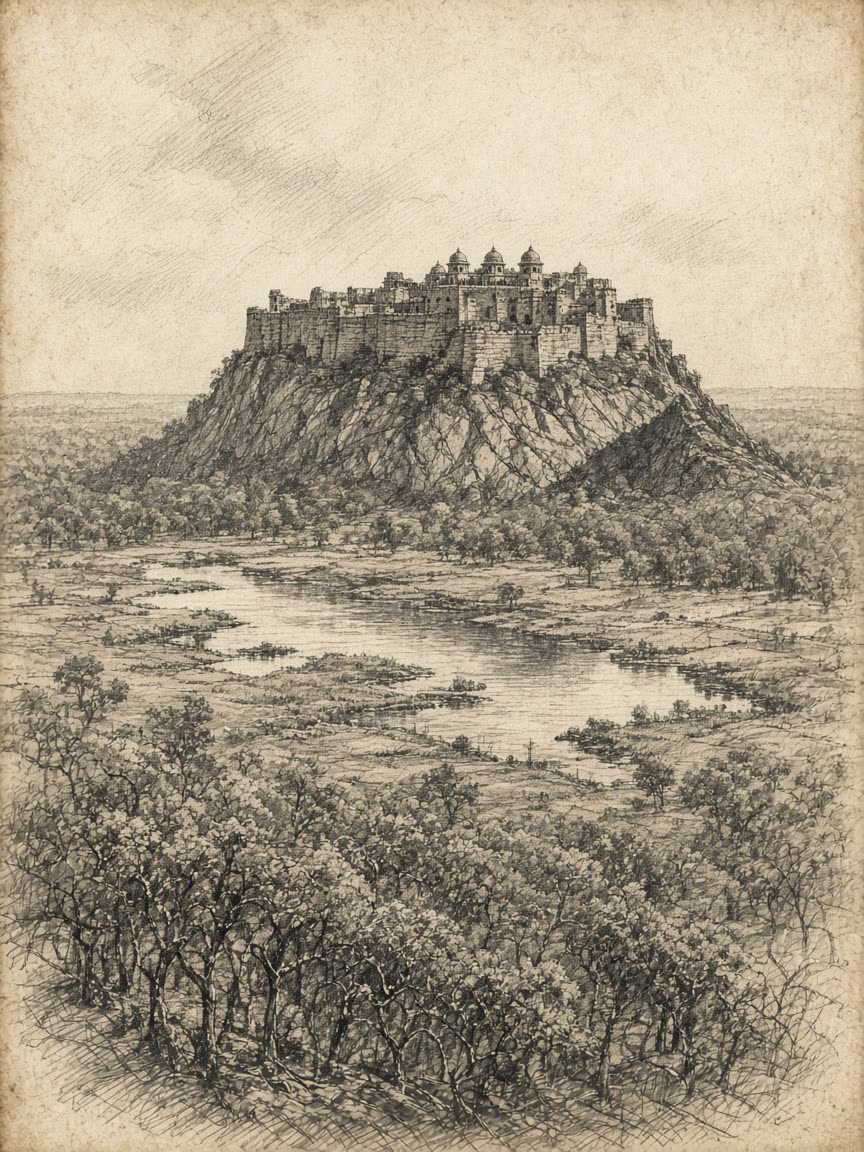
In winter the morning gate opens at 7:00; in summer at 6:00. The queue forms earlier. At the gate a forest official checks the permit against each guest's original ID, the guide is assigned, and the vehicles go in by zone. Zone 1 enters by Singh Dwar; operator sources do not name the gates for the other zones, and the guide knows. The first thing you notice in the old core is the fort above you on its cliff, 200 metres up, and the second is the cold. Winter mornings in Sawai Madhopur reach 2 degrees Celsius and an open jeep moving at speed makes it feel colder. Bring more layers than seems reasonable.
The first hour
The first hour is the working hour. The driver moves at a steady pace along the zone's track network while the guide listens. The night's pugmarks are still on the dust, and a fresh set crossing the track will stop the vehicle for a look at direction and size. Peafowl are calling, langurs are settling in the trees, and if a chital barks somewhere ahead the vehicle will stop and everyone will wait. This is when most sightings happen: a tiger walking back to cover after a night's hunting, or at a waterhole before the sun is on it. In the lakes zones, Padam Talao at first light with sambar in the water and the Jogi Mahal behind is the view people come for, with or without a tiger in it.
Alarm calls
Ranthambore's guides work by ear. A chital's alarm is a sharp bark, repeated; a sambar's is a deep bell; a langur's is a hacking cough from above. One call may be a leopard, a jackal or nothing. Several species calling from the same direction, and keeping it up, means a predator on the move, and the driver will position the vehicle where a track crosses the likely line. Sometimes the tiger appears. Sometimes the calls stop and whatever it was has lain down in the dhok, fifty metres away and invisible. The waiting is part of the drive, and a guest who treats it as dead time has missed what the guide is doing. The signs are explained on the tiger behaviour page.
The quiet middle
By the second hour the sun is up and the forest has changed. The birds are quieter, the deer are grazing, and the guide is working a circuit of the zone's water and crossings. This is the time for the rest of the park: a sloth bear on a rocky slope, crocodiles out on the lake margin, a crested serpent eagle on a bare dhok branch, the ruins between Raj Bagh and Padam Talao. In summer, from March to June, the forest is bare and brown and the heat is already building by nine; everything that can is lying up near water, and the guide goes from one pool to the next. In winter the forest is green and closed and the middle of the drive can be a long, pleasant, empty loop.
The people
Three people run your drive. The driver, who owns or works for the vehicle owner, knows the tracks and the other drivers, and the drivers talk to each other. The guide is assigned at the gate and is the person who knows the tigers by name and territory. Forest staff at the gate and on patrol inside are the third group, and the ones who carry the risk: a Range Officer was killed by a tigress at Jogi Mahal in May 2025 and a forest guard by the tiger Ustad in 2015. A tip to the driver and guide at the end of the drive is customary, and the guides' sighting logs are part of how the reserve keeps track of its tigers.
Walking, boats and the fort
There is no walking safari inside Ranthambore and no boat on its lakes; the park is a vehicle safari only. The one place you walk is the fort, on a separate visit, up a stone path to the Ganesh temple with the forest below you. Wednesday is the pilgrim day and the busiest. For a river, the Chambal is a day trip away with gharial and boat trips at Palighat; see nearby attractions. Parks where you can walk or take a boat are covered on our walking safaris and boat safaris pages.
Etiquette
- At a sighting, the vehicles arrive in sequence and the guide decides where to stop. Asking the driver to push forward is the one thing that makes the sighting worse for everyone, the tiger included.
- Keep your voice down. Tigers are used to engine noise and not to shouting.
- Watch for the first minute of any sighting before reaching for the camera.
- When the guide says it is time to move on, it is. Other vehicles are waiting their turn.
- Ask the guide about everything else. A guide who is asked about birds and trees will show you more of the forest than one who is only asked where the tiger is.
The drive with no tiger
It will happen, and if you do three drives it may happen on two. Sightings here are more frequent than in most Indian parks and still not guaranteed, and in the green months from October to February they drop. A drive with no tiger in Ranthambore is still a drive past a 10th-century fort, three lakes with crocodiles, sambar in the shallows, and a dry forest full of birds. The guides know it, which is why the good ones talk about the whole forest. We tell guests to book three or four drives across different zones and to go into each one for the forest. How many drives to book and when is on plan your visit and the best time page.
Sources
- ranthamboreexperience.in: safari timings (operator page)
- ranthamboretiger.com: how to book Ranthambore safari online (operator page) (2026-11-02)
- Rajasthan Tour Planner: Ranthambore safari zones (operator page)
- Wikipedia: Sawai Man Singh Wildlife Sanctuary
- Wikipedia: Ranthambore National Park
- Wikipedia: Ranthambore Fort
- The Statesman: forest ranger killed in tiger attack (2025-05)
- Wikipedia: T-24 (tiger)
- ranthamboretigerreserve.in (operator page)
FAQ
The Forest Experience: Ranthambore FAQ
- What time does a Ranthambore safari start?
- Morning shifts start between 6:00 and 7:00 depending on the season, afternoon shifts between 14:00 and 15:30, per operator timing tables. Each shift is about three and a half hours and you are collected from your hotel about 45 minutes before.
- Can you walk in Ranthambore National Park?
- Not inside the safari zones. The only walk is to the fort and the Trinetra Ganesh temple, on a separate visit outside the safari permit.
- What if I do not see a tiger in Ranthambore?
- It happens, especially in the green months from October to February. We recommend three or four drives across different zones. Every drive still covers the fort, the lakes, crocodiles, deer and more than 300 bird species.
Ready to see a wild tiger?
From the first call to the last transfer, we're with you. We book the safari zones the day they open, choose the lodges, arrange every train, flight and road journey, and stay on call while you travel.
Plan My Safari