Figures as of 2025-07-31 · page checked 2026-11-18
The mammals of Panna Tiger Reserve are listed by two official sources, the MP Forest eBrochure on MPOnline and the NTCA brief note, and filled in by Wikipedia and Roundglass. Between them they name tiger, leopard, wild dog (dhole), wolf, striped hyena, sloth bear, jungle cat and other small cats, rusty-spotted cat, Asian palm civet and other civets, mongoose, langur, sambar, chital, chowsingha, nilgai, chinkara and wild pig. The Indian fox was not found in any source and is left off. No official mammal species count exists for the reserve. What does exist is a herbivore density of over 40 per km², quoted by the Field Director in 2022 as one of the highest in dry deciduous forests.
Species table
The "where" column is habitat reasoning from the reserve's described terrain and standard natural history, not a Panna sighting log; the "notes" column carries anything a source said specifically about Panna.
| Species | Typical ground (general) | Notes from Panna sources |
|---|---|---|
| Tiger | Plateaus, gorges, Ken valley | Across about 800 km² of the reserve (2022); see the tigers page |
| Leopard | Cliffs, sehas, buffer scrub | Listed by MPOnline and NTCA; no count found |
| Wild dog (dhole) | Open deciduous forest | Listed by MPOnline and NTCA |
| Wolf | Scrub and open ground at the forest edge | Listed by MPOnline and NTCA |
| Striped hyena | Rocky slopes, nullahs, night | Listed by MPOnline and NTCA |
| Sloth bear | Rocky ground, mahua groves | Common in March–April during mahua season (Roundglass) |
| Jungle cat | Grass, scrub, river edge | Listed by MPOnline and NTCA |
| Rusty-spotted cat | Dry forest, rocky cover | Listed by Wikipedia |
| Asian palm civet, other civets | Trees, nocturnal | Wikipedia; Roundglass |
| Mongoose | Scrub, track edges | Roundglass |
| Langur | Canopy, cliff edges | Roundglass; the forest's alarm-caller |
| Sambar | Forest and water | Listed by MPOnline and NTCA |
| Chital | Open forest, meadows | Listed by MPOnline and NTCA |
| Chowsingha (four-horned antelope) | Dry hill forest | Listed by MPOnline and NTCA |
| Nilgai | Open scrub, buffer | Listed by MPOnline and NTCA |
| Chinkara | Dry open country | Listed by MPOnline and NTCA |
| Wild pig | Everywhere, especially near water | Listed by MPOnline and NTCA |
Sloth bear: the mahua months
The sloth bear is the mammal Roundglass singles out by season, and the reason is a tree. Mahua (Madhuca indica) is one of the dominant trees on the MPOnline list, and Roundglass reports that sloth bears are common in March and April during the mahua season, when the flowers fall and the bears come out to eat them. Those are also the first hot months, with leaf cover thinning, so a bear on a track in the morning is a realistic hope on a spring drive. Bears use the reserve's rocky ground and caves the rest of the year, which is standard behaviour for the species.
Wolf, wild dog and hyena: three predators, three habitats
The wolf is on both official lists. Wolves in India are animals of open scrub and grassland rather than closed forest, and the NTCA's list of forest types includes dry deciduous scrub along with the buffer's farmland edge. The wild dog, by contrast, is a pack hunter of deciduous forest, and the striped hyena is a scavenger of rocky slopes and nullahs that moves at night. All three are on the official lists; none has a Panna count. The buffer night safari is the only drive that overlaps with hyena hours.
Small cats: jungle cat and rusty-spotted cat
The MPOnline list says "jungle cat, smaller cats" and leaves it there; Wikipedia names the rusty-spotted cat, one of the world's smallest wild cats, which lives in dry forest and rocky cover of exactly Panna's type. A jungle cat in grass by the river at dawn is the more likely sighting; the rusty-spotted cat is a night animal, and a buffer night drive is the only realistic chance. The caracal was not found in any Panna source and is not claimed.
The herbivores
Sambar, chital, chowsingha, nilgai, chinkara and wild pig are the prey base, and the over-40-per-km² density is the figure the Field Director quoted in 2022. The chowsingha, the four-horned antelope, is a dry-hill specialist worth a careful look on the plateau tracks; chinkara favour the open, drier ground; nilgai are the big antelope of the buffer edge. Sambar at water and chital in the open forest are the common sightings, and their alarm calls are what guides listen for, explained on the tiger behaviour page.
What is not in Panna
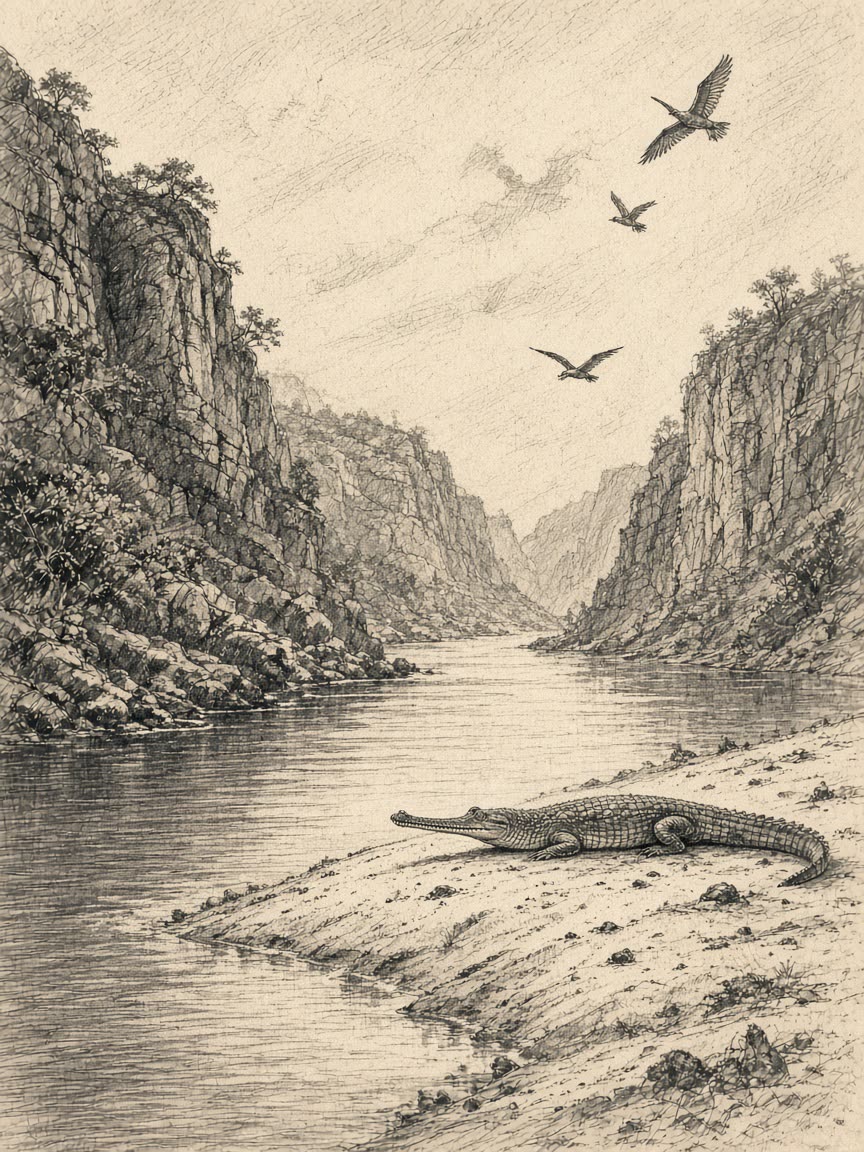
No source we checked lists elephant or gaur for Panna. Visitors who want gaur or wild elephant should look at our Satpura or Jim Corbett pages. For Panna's river animals, the gharial and mugger, go to reptiles, and for the wider habitat picture to the biodiversity overview.
FAQ
Mammals & Small Cats: Panna FAQ
- When is the best time to see sloth bears in Panna?
- March and April, during the mahua flowering season, when Roundglass Sustain reports sloth bears are common. Mahua (Madhuca indica) is one of the reserve's dominant trees.
- Are there wolves in Panna National Park?
- Yes. The wolf is on both the MP Forest eBrochure's and the NTCA brief note's mammal lists for Panna, alongside wild dog and striped hyena. No population figure is published.
- Does Panna have elephants or gaur?
- No source we consulted lists elephant or gaur for Panna. The reserve's large herbivores are sambar, chital, nilgai, chowsingha, chinkara and wild pig.
Ready to see a wild tiger?
From the first call to the last transfer, we're with you. We book the safari zones the day they open, choose the lodges, arrange every train, flight and road journey, and stay on call while you travel.
Plan My Safari