Figures as of 2026-02-22 · page checked 2026-11-18
Birds in Panna Tiger Reserve are counted three ways and the totals do not agree: the MP Forest eBrochure says more than 200 species, the NTCA brief note says over 150, and Roundglass Sustain gives 250–300. We quote all three. What no source disputes is the vulture story: Outlook Traveller reported in August 2026 that Panna hosts seven of India's nine vulture species, the cliffs of the Dhundua Seha gorge are an NTCA-named vulture hotspot, and the reserve's vulture censuses have risen from 722 birds in 2020–21 to 854 in summer 2024 and 1,127 in the South Panna Forest Division in early 2026.
Headline species from the official list
The MPOnline brochure names white-necked stork, bar-headed goose, honey buzzard, blossom-headed parakeet, paradise flycatcher, slaty-headed scimitar babbler and five vulture species. Between them those cover the Ken (stork and goose), the canopy (honey buzzard), the dry forest (parakeet), the shaded nullahs (flycatcher), the scrub (babbler) and the cliffs (vultures). Whether the paradise flycatcher is Madhya Pradesh's state bird we could not confirm from our sources, so we do not say so. The Malabar pied hornbill was not found in any Panna source and is not claimed.
Vultures: seven of nine
The species recorded in the reserve's censuses are the Indian long-billed vulture, red-headed vulture, Egyptian vulture, Eurasian griffon and Himalayan griffon, with the white-backed vulture listed as normally found. The radio-tagging report describes the griffons as migratory; as general ornithology, the long-billed, red-headed and white-backed vultures are residents. Vulture Point, where the 2025–26 naturalist diary records tigress P652 with three cubs, is named for the birds.
The counting is systematic. The summer 2024 census ran from 29 April to 1 May across 65 habitats and found 854 vultures, up from 722 in 2020–21. The first phase of the 2026 census recorded 1,127 in the South Panna Forest Division. In December 2020 Panna and the Wildlife Institute of India began radio-tagging vultures, with a target of 25 birds across long-billed, red-headed, Eurasian griffon and Himalayan griffon; Free Press Journal reported in February 2022 that these were the first migratory vultures radio-tagged in India, and Outlook Traveller later noted tagged birds averaging about 132 km a day. A vulture breeding centre at Panna was not found in any source. The monitoring side of this is on the wildlife monitoring page.
The Ken: waterbirds from a boat
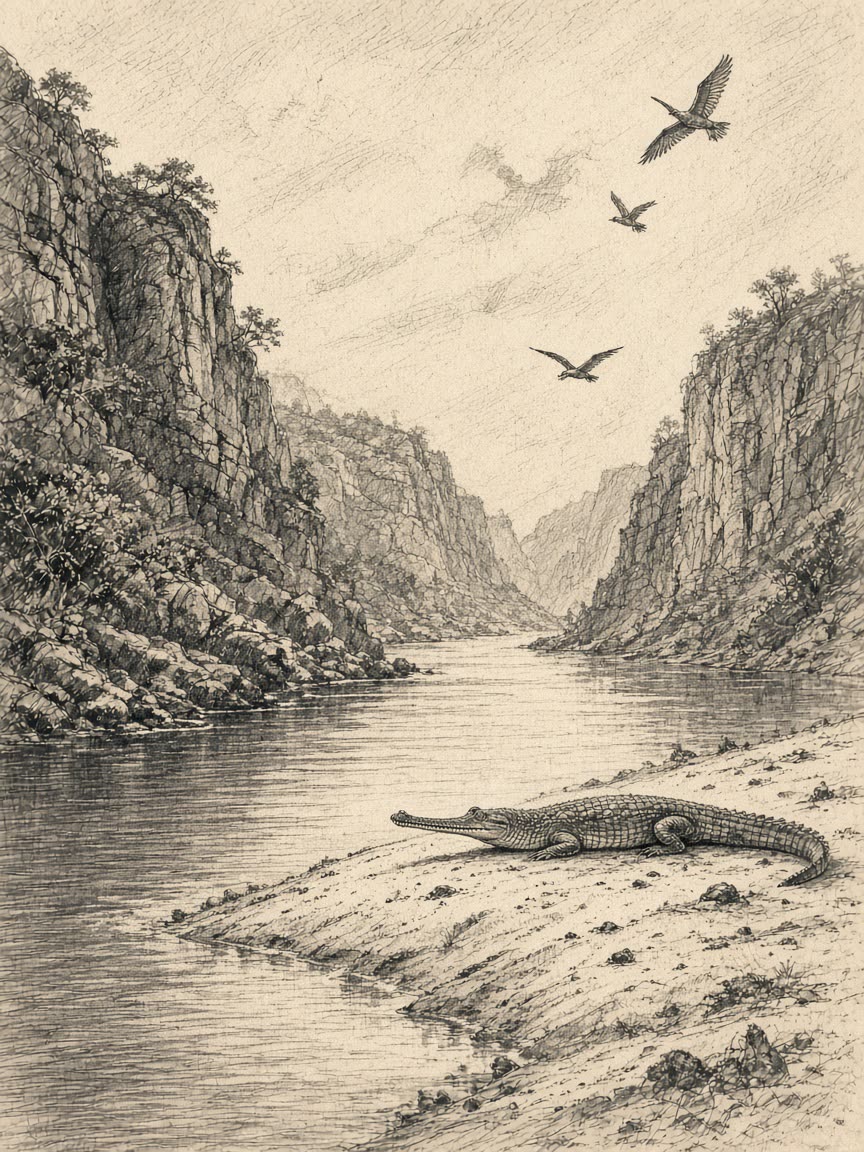
The boat safari from the Bhoura Dau jetty on the Ken is, by Roundglass's description, the trip for waterbirds and crocodiles. The river is perennial and, per the NTCA, one of the least polluted in the state; white-necked storks and bar-headed geese are on the official list. Trawell's undated listing puts the boat about a kilometre from the Madla gate, running 7 to 9 in the morning and 4 to 5 in the afternoon for about an hour at ₹150 a person; Tigerwalah reports it resumed for the 2025–26 season after a long break and was then suspended mid-season for operational reasons, so check before you count on it. Details and caveats are on the jeep and canter safari page.
Best birding months and spots
Roundglass dates the arrival of migratory birds from late October, which lines up with the core reopening on 1 October and the cooler weather the MPOnline brochure gives for November (18–25 °C) and December (8–18 °C). The winter months bring the griffons to the cliffs and the geese to the river. The summer census window at the end of April shows that vultures are countable in the heat too, when the dry forest has lost its leaves and the birds sit out on the escarpments. For spots: the Ken by boat, the Dhundua Seha gorge and Vulture Point for the cliff species, and the buffer zones, open year-round, for scrub birds in the monsoon when the core is shut. The best time to visit Panna page lays this out month by month.
What a birder should carry
No official source lists what to carry, so this is our field team's advice. Binoculars of 8x or 10x; a camera with reach for the cliffs, where the vultures are high and the light is behind them in the morning; a field guide to Indian birds; and layers, because a January dawn in Panna can drop to 4 °C with frost while a May afternoon reaches 45 °C. On the boat, a dry bag and a hat. Tell the guide at the gate that birds are the priority; a drive that stops for babblers has to be asked for.
Ten to look for
- Indian long-billed vulture, on the escarpment ledges
- Red-headed vulture, the rarest of the residents
- Egyptian vulture, small and pale, often near villages in the buffer
- Eurasian griffon, a winter visitor on the cliffs
- Himalayan griffon, the largest of the winter arrivals
- White-necked stork, along the Ken
- Bar-headed goose, on the river in winter
- Honey buzzard, over the forest canopy
- Blossom-headed parakeet, in the teak and mixed forest
- Paradise flycatcher and slaty-headed scimitar babbler, in the shaded nullahs and scrub
For the habitats these birds depend on, start with the biodiversity overview; for the river's other residents, the gharial and mugger, see reptiles.
Sources
- MP Forest eBrochure, Panna (MPOnline)
- NTCA brief note on Panna Tiger Reserve
- Roundglass Sustain: guide to Panna Tiger Reserve (2025-07-31)
- Outlook Traveller: Madhya Pradesh's vulture comeback (2026-08-23)
- Free Press Journal: 854 vultures in Panna summer census (2024-05-02)
- Lokmat Times: Panna records 1,127 vultures (2026-02-22)
- Free Press Journal: migratory vultures radio-tagged in Panna (2022-02-12)
- Tigerwalah: Naturalist diaries, Panna season end 2025–26 (2026-10-01)
- Trawell: Ken River boating
- Indian Masterminds: Panna tourism record, core closed for monsoon (2025-07-04)
FAQ
Birds: Panna FAQ
- How many vulture species are found in Panna?
- Seven of India's nine, according to Outlook Traveller in August 2026. Census records name the Indian long-billed, red-headed, Egyptian, Eurasian griffon and Himalayan griffon, with the white-backed vulture listed as normally found.
- How many vultures were counted in Panna?
- 722 in 2020–21, 854 in the summer 2024 census held from 29 April to 1 May across 65 habitats, and 1,127 in the South Panna Forest Division in the first phase of the 2026 census.
- When do migratory birds arrive in Panna?
- From late October, according to Roundglass Sustain. The core zones reopen on 1 October after the monsoon closure, and November to February brings the coolest weather and the wintering griffons and geese.
Ready to see a wild tiger?
From the first call to the last transfer, we're with you. We book the safari zones the day they open, choose the lodges, arrange every train, flight and road journey, and stay on call while you travel.
Plan My Safari