Figures as of 2026-11-18 · page checked 2026-11-18
Panna Tiger Reserve's wildlife is shaped by three things: table-top plateaus, deep rocky gorges, and the Ken River, which enters from the south and flows north through the reserve for about 55 km. The NTCA brief note describes the terrain as two parallel plateaus running south-west to north-east, with cliffs, talus slopes and rocky escarpments known locally as "sehas". The Field Director's site names three tablelands on the Panna side, Talgaon, Hinauta and the Ken valley, with undulating hills on the Chhatarpur side. Altitude runs from 211.2 m at the Ken to 540 m at a hillock near Talgaon, on Lower Vindhyan geology, with average rainfall of 1,100 mm.
Each group has its own page: tigers, leopards, mammals and small cats, birds and reptiles.
Forest types: teak at its northern limit
The NTCA lists five forest types in the reserve: southern tropical dry deciduous dry teak forest, northern tropical dry deciduous mixed forest, dry deciduous scrub, Boswellia forest and dry bamboo brakes. Along the Ken, a strip of Anogeissus pendula (kardhai) forest half a kilometre to a kilometre wide runs from Pipartola to the Gangau dam. Panna is the northernmost limit of natural teak and the easternmost limit of natural kardhai forest, per the Field Director's site.
The MPOnline brochure names the dominant trees: teak (Tectona grandis), tendu (Diospyros melanoxylon), mahua (Madhuca indica), Buchanania, Anogeissus latifolia and pendula, Lannea and salai (Boswellia serrata). Roundglass notes that sloth bears are common in March and April, the mahua flowering months.
The Ken: water, gorges and gharial
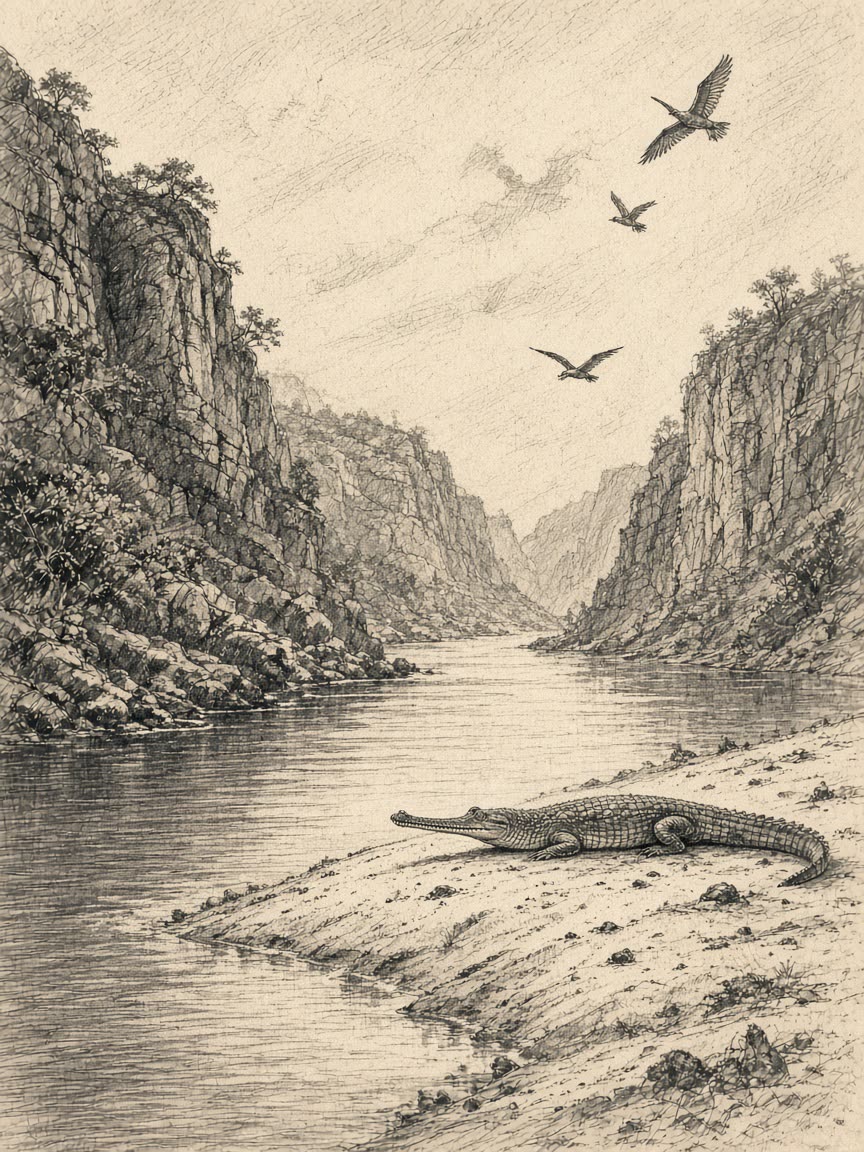
The Ken is a tributary of the Yamuna and one of 16 perennial rivers in Madhya Pradesh. The NTCA calls it one of the least polluted rivers in the state. It forms part of the park's western boundary and also runs through the reserve, and it is home to both gharial and mugger crocodiles. The NTCA brief note records over 50 fish species, including two globally threatened mahseer species. The NTCA names the Dhundua Seha gorge, where the river has cut into the plateau, as a hotspot for both tigers and vultures.
Downstream, the 78.53 km² Ken Gharial Sanctuary at the Ken-Khudar confluence protects the gharial at Raneh Falls. A boat safari from the Bhoura Dau jetty covers the waterbirds and crocodiles; see the jeep and canter safari page.
Species counts, with the figure each source gives
| Group | Figure | Source |
|---|---|---|
| Birds | More than 200 species | MP Forest eBrochure (MPOnline) |
| Birds | Over 150 species | NTCA brief note |
| Birds | 250–300 species | Roundglass Sustain, 31 Jul 2025 |
| Vultures | Seven of India's nine vulture species | Outlook Traveller, 23 Aug 2026 |
| Reptiles | Over 10 species | NTCA brief note |
| Fish | Over 50 species incl. two globally threatened mahseer species | NTCA brief note |
| Herbivore density | Over 40 per km², one of the highest in dry deciduous forests | Indian Masterminds, 29 Aug 2022 |
| Tigers | Around 80 (Better India) vs more than 100 (The Week), both July 2026 | See the tigers page for the full table |
The three bird counts differ by a factor of two, so we give all three. No official mammal or plant species count was found, and no leopard count exists in any source we checked.
Mammal list
The MPOnline brochure and the NTCA note list tiger, leopard, wild dog (dhole), wolf, striped hyena, sloth bear, jungle cat and smaller cats, sambar, chital, chowsingha (four-horned antelope), nilgai, chinkara and wild pig. Wikipedia adds rusty-spotted cat and Asian palm civet; Roundglass adds mongoose, langur and civets. The 2022 figure of over 40 herbivores per km² is described as one of the highest in dry deciduous forests. Each species gets a line in the mammals guide.
Birds and vultures
Vulture censuses give the scale: 722 birds in 2020–21, 854 in the summer 2024 census (29 April to 1 May, across 65 habitats), and 1,127 in the South Panna Forest Division in the first phase of the 2026 census. Migratory birds arrive from late October. The birds page has the headline species, the radio-tagging programme and a ten-to-look-for list.
The seasonal rhythm
The MPOnline brochure gives January minimum 4 °C with frost possible, May maximum 45 °C, monsoon from the second week of June, November 18–25 °C, December 8–18 °C. The core closes from 1 July to 30 September and reopened on 1 October in 2025; the buffer gates stay open through the monsoon. Roundglass's reading of the year is that summer (March to June) gives better sightings at waterholes, sloth bears are commonest in March and April, and migratory birds arrive from late October. MPOnline's best-time window is 15 October to 15 June; the Field Director's site narrows it to November to March. Our own month-by-month advice is on the best time to visit Panna page.
Where in the park each habitat is
The Madla gate on NH-39 opens onto the Ken valley and the lower plateau, which is where the boat jetty is, about a kilometre from Madla by Trawell's account. The Hinauta gate, 30 km from Madla, sits on the middle plateau that carries its name. The Talgaon Plateau is the upper tableland. Buffer gates at Akola, Harsa and Khajurikudar give access to the mixed forest and scrub around the core, and the night safari runs in the buffer. The kardhai strip and the gorges are along the Ken. For how these translate into safari zones, vehicle caps and entry points, see the Panna zones guide.
Sources
- NTCA brief note on Panna Tiger Reserve
- Panna Tiger Reserve, Field Director's site: The Park
- MP Forest eBrochure, Panna (MPOnline)
- Roundglass Sustain: guide to Panna Tiger Reserve (2025-07-31)
- Wikipedia: Panna National Park
- Indian Masterminds: From zero to eighty tigers (2022-08-29)
- Outlook Traveller: Madhya Pradesh's vulture comeback (2026-08-23)
- Free Press Journal: 854 vultures in Panna summer census (2024-05-02)
- Lokmat Times: Panna records 1,127 vultures (2026-02-22)
- Indian Masterminds: Panna tourism record, core closed for monsoon (2025-07-04)
- Panna Tiger Reserve tourist information
- Trawell: Ken River boating
- The Better India: Panna's recovery and the Ken-Betwa project (2026-07-23)
- The Week: Can India's tiger success story be sustained? (2026-07-26)
FAQ
Biodiversity: Panna FAQ
- How many bird species are in Panna?
- Sources disagree. The MPOnline brochure says more than 200 species, the NTCA brief note says over 150, and Roundglass Sustain gives 250–300. Panna also hosts seven of India's nine vulture species.
- What river flows through Panna Tiger Reserve?
- The Ken River, a tributary of the Yamuna, enters from the south and flows north through the reserve for about 55 km. It is one of Madhya Pradesh's 16 perennial rivers and holds gharial, mugger and over 50 fish species.
- What forest type is Panna?
- Mainly dry deciduous teak and mixed forest, with dry scrub, Boswellia (salai) forest and bamboo brakes. Panna is the northernmost limit of natural teak and the easternmost limit of natural kardhai (Anogeissus pendula) forest.
Ready to see a wild tiger?
From the first call to the last transfer, we're with you. We book the safari zones the day they open, choose the lodges, arrange every train, flight and road journey, and stay on call while you travel.
Plan My Safari