The forest experience at Panna begins before the gate. At Madla, the core's busier entry on NH-39, up to 37 vehicles line up for the morning round in the dark; at Hinauta, 30 km away on the middle plateau, there are nine. The official timings open the core at sunrise, which in a Panna January can mean 4 °C and frost on the seat cushions, and in May means a sun that will push the day to 45 °C by afternoon. Permits are checked against original photo ID, the guide climbs aboard, and the drive begins. Vehicles, fees and timings are on the jeep and canter safari page.
The first hour
From Madla the tracks start in the Ken valley and climb. The first hour is for the river edge and the kardhai strip along it, the half-kilometre to one-kilometre band of Anogeissus pendula forest that the NTCA describes running from Pipartola to the Gangau dam. The dust on these tracks holds the night's pugmarks. From Hinauta the start is already on the plateau, in the dry teak and mixed forest, and the first hour is a loop toward the escarpment edges. In both, the guide is listening more than looking. The animals that are up at that hour, sambar at the water, chital in the open, langur on the cliff edge, are the alarm system for everything else.
Alarm calls and the quiet middle
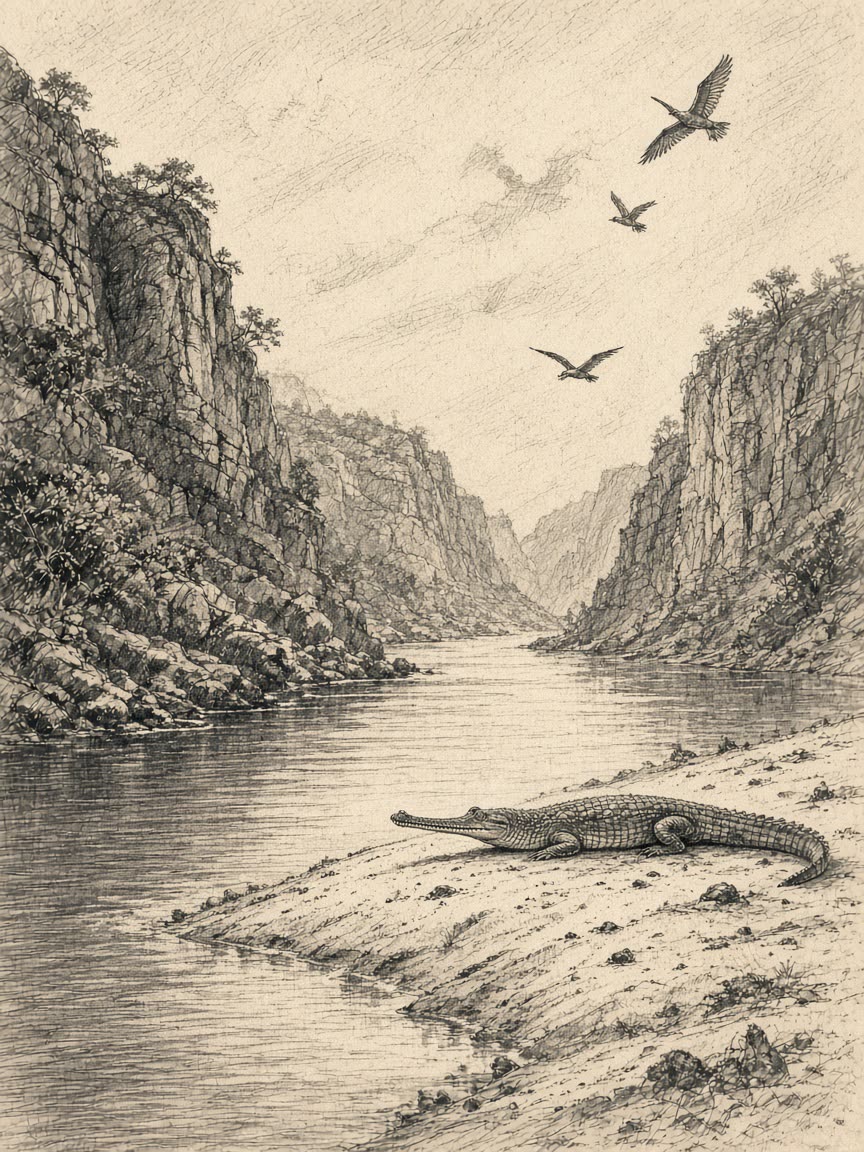
The middle hour of a drive is spent waiting. The vehicle parks at a waterhole, a gorge edge or a bend of the Ken and waits. Guides read a chital bark or a sambar bell for direction and repetition; one call means little, a chain of calls moving along the plateau edge means something is walking. It is when the rest of the reserve shows itself: the vultures lifting off the Dhundua Seha cliffs as the thermals build, a jungle cat crossing the track, a mugger on a sandbank. The tiger behaviour page explains the signs in more detail.
The people
Every vehicle carries a forest department guide, hired per round at ₹480 by the official schedule, and a driver from the registered gypsy pool. The guide's word is final in the vehicle. Panna's guides and drivers hold the sighting knowledge that the P-numbers in the 2025–26 naturalist diaries depend on: which tigress is denning at Vulture Point, where the dominant male has been crossing. Beyond the gate are the range office and the patrol teams whose work shows in the record, from the patrol staff who found founder T1 at the end of her life to the camera-trap crews who check traps weekly. The lodges add naturalists of their own; ours are matched on the Panna hotels page.
Boat, night and walking
Panna offers two things most tiger reserves do not. The boat on the Ken, from the Bhoura Dau jetty about a kilometre from Madla, puts you at water level with the crocodiles and the waterbirds, and in 2025–26 gave sightings of a tigress and cubs on the bank; it was then suspended mid-season, so do not plan around it. The buffer night safari, 18:00 to 21:00, is the forest after dark with a spotlight, and the animals on the night list, hyena, civet, jungle cat, are the ones the day drives never show. No official walking safari inside the core was found in any source; walks at lodges in the buffer are a lodge matter, and our walking safaris page sets expectations for India in general.
Etiquette in a small reserve
Nine vehicles at Hinauta can leave a tigress with cubs calm or can surround her. Keep voices down at a sighting, no standing on the seats, no calling to animals, no asking the driver to leave the track or stay past the closing time, which is 11:00 in the morning and sunset in the afternoon. Let the guide decide how close is close. The forest department's monitoring, described on the wildlife monitoring page, depends on animals behaving as they would without us.
The drive with no tiger
Most drives in any reserve end without a tiger. What a tiger-less Panna drive gives you is still particular to this forest: two plateaus and a gorge, a river that is one of the cleanest in Madhya Pradesh, seven vulture species on the cliffs, a sloth bear if it is March or April and the mahua is falling, and, with a full-round permit, a stop at Pandav Falls, the 30 m drop into a heart-shaped pool that is included free. Two or three drives across both core gates change the odds. The best time to visit page lays out the seasonal trade-offs, and safari booking explains how to spread the permits.
Sources
- MP Forest eBrochure, Panna (MPOnline)
- Panna Tiger Reserve tourist information
- NTCA brief note on Panna Tiger Reserve
- Roundglass Sustain: guide to Panna Tiger Reserve (2025-07-31)
- Tigerwalah: Naturalist diaries, Panna season end 2025–26 (2026-10-01)
- Trawell: Ken River boating
- TOI via inkl: T1 tigress found dead
- Panna Tiger Reserve: Yearly Review of Tiger Population 2021 (2022-01-31)
- Outlook Traveller: Madhya Pradesh's vulture comeback (2026-08-23)
- Incredible India: Pandav Falls
FAQ
The Forest Experience: Panna FAQ
- What time does a Panna safari start?
- Core gates open at sunrise, with the morning round ending at 11:00. Afternoon rounds begin at 15:00 from October to February and 16:00 from March to June, and end at sunset. Night safaris in the buffer run 18:00 to 21:00.
- Can you walk inside Panna National Park?
- No official walking safari inside the core was found in any source. Panna's alternatives to the jeep are the boat safari on the Ken from the Bhoura Dau jetty, when it is operating, and the buffer night safari.
- What if we do not see a tiger in Panna?
- Most drives in any reserve end without one. Panna's drives still cover the Ken, two plateaus, cliffs with seven vulture species, sloth bears in mahua season and Pandav Falls, which is included free with a full safari round. Booking two or three drives across both core gates improves the odds.
Ready to see a wild tiger?
From the first call to the last transfer, we're with you. We book the safari zones the day they open, choose the lodges, arrange every train, flight and road journey, and stay on call while you travel.
Plan My Safari