Figures as of 2026-11-18 · page checked 2026-11-18
The conservation history of Panna Tiger Reserve has one collapse, one recovery and, now, a dam. The reserve was declared under Project Tiger in 1994; by 2009 it had no tigers; by 2012 it had won a national award for bringing them back; and since 2016 a river-linking project has been clearing the legal steps needed to submerge part of the core. The tigers' own numbers and the founders' biographies are on the tigers page; the collars, camera traps and censuses are on the wildlife monitoring page.
Timeline
| Date | Event | Source |
|---|---|---|
| 1975 | Gangau Wildlife Sanctuary formed from territorial forests | pannatigerreserve.in |
| 1981 | Panna National Park created | pannatigerreserve.in |
| 1994 | Project Tiger reserve: 22nd in India, 5th in MP | pannatigerreserve.in |
| 2007 | Ministry of Tourism Award of Excellence, best-maintained national park | Wikipedia |
| Mar 2009 | Last male already gone; tigresses T1 (Bandhavgarh, 4 Mar) and T2 (Kanha) brought in | TOI via inkl; PTR press note 2012 |
| Jun 2009 | Officials announce no tigers remain except the two introduced tigresses | Wikipedia |
| Nov–Dec 2009 | Male T3 from Pench arrives, walks out toward Pench, re-released 26 Dec | PTR press note 2012; Wikipedia |
| Apr 2010 | First litter born in the reserve since the extinction | Indian Masterminds 2022; Deccan Herald |
| 2011 | Panna nationally notified as a biosphere reserve | The Hitavada 2020 |
| 2012 | Buffer declared; NTCA Award of Excellence (Active Management); 18 tigers by 25 Dec | NTCA brief note; PTR press note |
| 2014 | Last translocated tiger brought in; T4 dies of a radio-collar infection on 19 Sep | Indian Masterminds 2022; Wikipedia |
| 2016 | Wildlife clearance for the Ken-Betwa link project | PIB FAQ, updated 18 Nov 2026 |
| 25 Aug 2017 | Environmental clearance for Ken-Betwa; Tribal Affairs clearance the same year | PIB FAQ |
| 2019 | 54 tigers | The Better India 2026; The Hitavada 2020 |
| Oct 2020 | UNESCO lists Panna in the World Network of Biosphere Reserves | The Hitavada, 1 Nov 2020 |
| Dec 2020 | Vulture radio-tagging with WII begins | Free Press Journal, 12 Feb 2022 |
| 2021 | NMDC Majhgawan diamond mine shut over wildlife concerns; tiger P234-31 Heera poached in Satna after leaving the reserve | Indian Masterminds 2026; Free Press Journal 2021 |
| 3 Oct 2023 | Forest clearance for Ken-Betwa | PIB FAQ |
| Mar 2024 | Majhgawan mine resumes; permit extended to 2035 | Indian Masterminds, 17 Sep 2026 |
| 25 Dec 2024 | Prime Minister lays the foundation stone of the Ken-Betwa project | PIB FAQ |
| 2025 | Madhya Pradesh records 55 tiger deaths in the year | The Week, 26 Jul 2026 |
| Jul 2026 | Dainik Bhaskar (via Better India) reports Ken-Betwa clearances lapsed and work continuing without forest department approval | The Better India, 23 Jul 2026 |
The 2009 collapse
Panna had an estimated 24–40 tigers in the early 2000s (over 40 by a Times of India figure cited by Wikipedia). Then the males disappeared. The reserve's own December 2012 press note describes Panna as a "zero tiger park after its original males disappeared", and in June 2009 officials announced that no tigers remained other than two tigresses that had just been brought in. Poaching is the implied cause in every account; The Hindu reported in 2012 that the state did not refer the case to the CBI. The Ministry of Tourism had named Panna best-maintained national park in 2007, two years earlier.
The reintroduction decision
The programme was developed with the Wildlife Institute of India and approved by the NTCA, with six founders planned and five reintroduced by 2012, according to the 2012 press note. R. Sreenivasa Murthy was the Field Director who ran it; The Week records that his team reintroduced seven tigers and that there were 32 when he left. The Better India attributes the programme to the MP Forest Department, WWF and the Panna management and dates its start to June 2009, which conflicts with the March 2009 arrival dates for T1 and T2 given by the Times of India and the reserve's own press note; we give both dates. The 2022 Field Director account says the tigers brought in over roughly five years were five males and two females, while The Better India counts five females and two males among the seven; both are quoted.
The NTCA's Award of Excellence for Active Management followed in 2012. Space was the other requirement. The NTCA records that 13 of the 16 villages inside the core were voluntarily relocated; the 2022 Field Director account says 16 villages were shifted out. The buffer still has 49 villages.
Dispersal, corridors and losses
By the 2021 Yearly Review more than 35 tigers had dispersed, to Chitrakoot, Bandhavgarh, the Satna forests and Nauradehi sanctuary. The NTCA sees Panna as the link between the Aravalli and Vindhyan tiger populations and names corridors toward Bandhavgarh, Nauradehi, Chitrakoot and Sagar, with a 30 km gap along the Ken and Midhassan rivers toward Bandhavgarh that needs restoration. In October 2021 P234-31 "Heera" was poached in Satna district three months after leaving. The Week reports 55 tiger deaths in Madhya Pradesh in 2025.
The Ken-Betwa river link
The facts below are from the Press Information Bureau's FAQ as updated on 18 November 2026 unless stated otherwise. The project costs ₹44,605 crore. Its Daudhan Dam, 96.7 m high, is to be built on the Ken in Panna and Chhatarpur districts about 40 km from Khajuraho, with a 216.465 km link canal to Barua Sagar near Jhansi. Clearances came in sequence: wildlife in 2016, environmental on 25 August 2017, Tribal Affairs in 2017, and forest on 3 October 2023. The Wildlife Institute of India prepared an Integrated Landscape Management Plan overseen by a Greater Panna Landscape Council. The Prime Minister laid the foundation stone on 25 December 2024. The dam is under construction, the canal has not begun, and completion is scheduled for 2030.
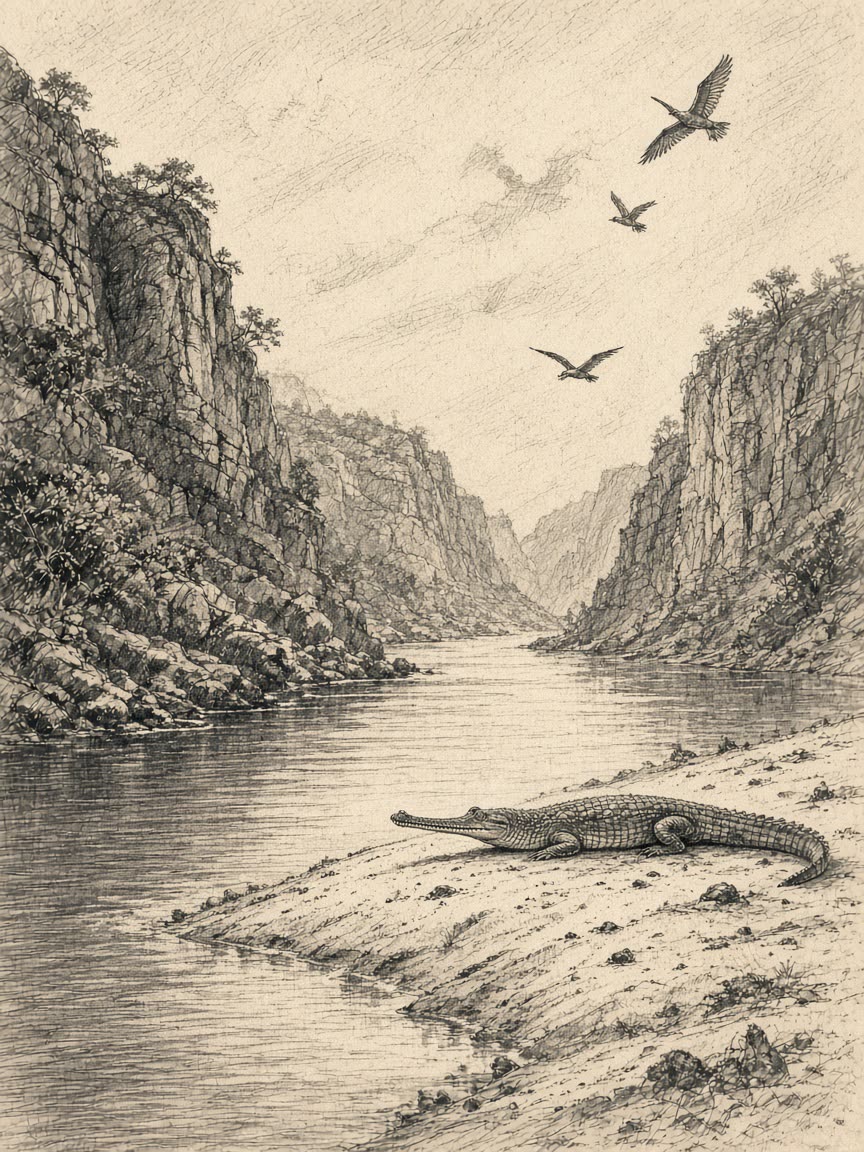
Estimates of the loss to the reserve differ. A 2021 study in Current Science, cited by The Better India, put direct submergence at 58.03 km², about 10% of the critical tiger habitat, with a further loss of more than 105 km² through indirect effects. SANDRP, writing in Counterview in May 2026, puts the submerged forest inside the reserve at 6,017 hectares and notes that the Forest Advisory Committee recorded 46 lakh trees of more than 20 cm girth to be felled, with reduced flows expected at the Ken Gharial Sanctuary and Raneh Falls. The same piece says a Central Empowered Committee report to the Supreme Court was never formally considered. In July 2026, Dainik Bhaskar, as reported by The Better India, said the clearances had lapsed and work was continuing without the forest department's sign-off. We did not find the date of any NTCA approval.
Other live issues
The NMDC diamond mine at Majhgawan, about 20 km from Panna and inside the wider forest landscape, was shut in 2021 over wildlife concerns and resumed in March 2024 with its permit extended to 2035. Tourism pressure is rising: the reserve recorded 2.75 lakh visitors and ₹7.42 crore in revenue in 2024–25, both records. A 25–50% hike in safari fees was proposed in October 2023, though its approval is unconfirmed. Permits are on the safari booking page and planning on the plan your visit page.
Sources
- Panna Tiger Reserve, Field Director's site: The Park
- Panna Tiger Reserve press note, 25 Dec 2012 (2012-12-25)
- Wikipedia: Panna National Park
- NTCA brief note on Panna Tiger Reserve
- The Week: Can India's tiger success story be sustained? (2026-07-26)
- The Better India: Panna's recovery and the Ken-Betwa project (2026-07-23)
- Indian Masterminds: From zero to eighty tigers (2022-08-29)
- Deccan Herald: Three tiger cubs join Panna
- TOI via inkl: T1 tigress found dead
- PIB FAQ: Ken-Betwa Link Project (2026-11-18)
- Counterview (SANDRP): Ken-Betwa link threatens forests and tigers (2026-05-05)
- The Hitavada: Panna listed as UNESCO biosphere reserve (2020-11-01)
- Free Press Journal: migratory vultures radio-tagged in Panna (2022-02-12)
- Free Press Journal: over 30 tigers left Panna to find new territory (2021-11-02)
- Panna Tiger Reserve: Yearly Review of Tiger Population 2021 (2022-01-31)
- Indian Masterminds: NMDC 27.29-carat diamond at Panna (2026-09-17)
- Indian Masterminds: Panna tourism record, core closed for monsoon (2025-07-04)
- The Hitavada: Tiger reserves to reopen from Oct 1 with 25% fee hike (2023-09-30)
FAQ
Conservation History: Panna FAQ
- Why did Panna lose all its tigers in 2009?
- The reserve's males disappeared, with poaching implied in every account, and by June 2009 officials announced no tigers remained apart from two tigresses just brought in from Bandhavgarh and Kanha. The Hindu reported that the state did not refer the case to the CBI.
- What is the Ken-Betwa link project and how does it affect Panna?
- A ₹44,605 crore scheme to build the 96.7 m Daudhan Dam on the Ken inside Panna and Chhatarpur districts and a 216 km canal to the Betwa. Its foundation stone was laid on 25 December 2024 and completion is scheduled for 2030. A 2021 Current Science study estimated 58.03 km² of direct submergence, about 10% of the core, plus over 105 km² of indirect loss.
- Did Panna win any conservation awards?
- Yes. The Ministry of Tourism named it best-maintained national park in 2007, and the NTCA gave it the Award of Excellence for Active Management in 2012 for the tiger reintroduction. UNESCO added Panna to its World Network of Biosphere Reserves in 2020.
- How many villages were relocated from Panna's core?
- The NTCA brief note says 13 of 16 villages in the core were voluntarily relocated; a 2022 account from the Field Director says 16 villages were shifted out. The buffer zone still has 49 villages.
Ready to see a wild tiger?
From the first call to the last transfer, we're with you. We book the safari zones the day they open, choose the lodges, arrange every train, flight and road journey, and stay on call while you travel.
Plan My Safari